Table of Contents
1. Introduction & Overview
This document analyzes a research proposal for a blockchain-powered platform designed to tokenize real-world and synthetic assets. The core thesis is to leverage blockchain's inherent properties—decentralization, immutability, and transparency—to create a more secure, user-friendly, and accessible system for asset ownership representation and transfer. The platform aims to address critical market gaps, including complex interfaces, high costs, and centralized control prevalent in existing solutions.
2. Core Concepts & Problem Definition
2.1 Tokens on a Blockchain
Tokens are programmable digital units built atop existing blockchain networks (e.g., Ethereum). Initially for crowdfunding, their utility has expanded to facilitate transactions, govern decentralized applications (DApps), and crucially, represent ownership of both digital and physical assets. Examples range from utility tokens (UNI) to non-fungible tokens (NFTs) like CryptoPunks.
2.2 Synthetic Assets
These are tokenized representations of real-world assets (RWA)—such as real estate, commodities, or securities—or purely digital constructs. The tokenization process endows these assets with crypto-native properties: immutability (tamper-proof record), divisibility (ownership of fractions), and enhanced liquidity.
2.3 The Tokenization Process
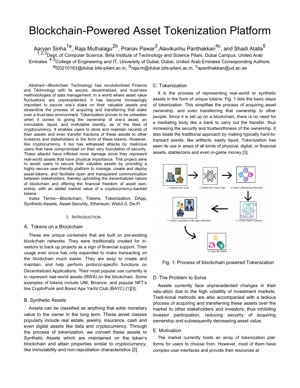
The paper outlines a fundamental process (Fig. 1): 1) Asset Identification & Valuation, 2) Legal Structuring & Compliance, 3) Token Creation & Smart Contract Deployment, 4) Custody/Management Solution, and 5) Trading/Liquidity Provision. This process bypasses traditional intermediaries like banks, aiming to reduce friction and cost.
2.4 The Problem Statement
The authors identify a triad of issues: High Market Volatility affecting asset valuation, Tedious Traditional Processes for asset transfer that hinder participation, and a resultant Decrease in Perceived Asset Security and Value.
2.5 Market Motivation & Gaps
Current platforms are criticized for poor user experience (complex UI), high cost structures (initial and recurring fees), and organizational centrality that erodes trust—a paradox in a domain built on decentralization. These factors contribute to low adoption.
3. Platform Contributions & Proposed Solution
The proposed platform's key contributions, as inferred, aim to directly counter the identified flaws:
- Enhanced Security: Focusing on mitigating attacks that compromise tokenized assets, which represent real-world value.
- User-Centric Design: Prioritizing a user-friendly interface to lower the barrier to entry.
- Decentralization & Transparency: Facilitating open communication between stakeholders to uphold blockchain's core ethos.
- Financial Freedom & Liquidity: Combining asset ownership benefits with the market dynamics of cryptocurrency.
The platform is positioned as a tool for users to create, manage, and deploy asset tokens securely.
4. Technical Deep Dive & Analysis
4.1 Core Insight & Analyst's View
Core Insight: This paper correctly identifies the central tension in asset tokenization: bridging the high-stakes, legally-complex world of RWAs with the permissionless, code-is-law ethos of blockchain. The real innovation isn't just creating another token minting tool, but attempting to build a security-first, user-abstraction layer for this complex bridge.
Logical Flow: The argument flows logically from problem (volatile, illiquid, insecure assets) to solution (blockchain tokenization), then crucially identifies why current solutions fail (UX, cost, centrality). The proposed platform is the synthesis. However, the flow stumbles by not detailing how it achieves superior security—the most critical claim.
Strengths & Flaws:
Strengths: Pinpoints real market pain points (cost, complexity). Rightly emphasizes security as paramount for RWAs. Acknowledges the trust erosion from centralized platforms in DeFi.
Critical Flaws: The paper is conspicuously light on technical architecture. How does it prevent the "attacks by malicious users" it mentions? Where is the discussion on oracle security for pricing RWAs, or legal compliance frameworks? As noted in the IEEE Symposium on Security and Privacy reviews of DeFi protocols, security claims without mechanistic detail are a major red flag. The contribution section is cut off, leaving its most concrete proposals unknown.
Actionable Insights: For this project to be credible, the next iteration must: 1) Detail the security model—is it formal verification of smart contracts, decentralized custody, or insurance pools? 2) Provide a clear UI/UX prototype demonstrating its "user-friendly" claim. 3) Outline a go-to-market strategy that addresses regulatory onboarding, the biggest hurdle for RWA tokenization, as highlighted by the Bank for International Settlements (BIS) in its 2023 report on tokenization.
4.2 Technical Details & Mathematical Framework
While the PDF lacks explicit formulas, the underlying tokenization system relies on smart contract logic. A basic representation of a token's ownership could be modeled as a state mapping:
$\text{Ownership}: \, O(a, t) \rightarrow \{0,1\}$
Where $O(a,t)=1$ if address $a$ owns token $t$, else $0$. For fractional ownership (e.g., for real estate), a mapping to a real number is used:
$\text{Balance}: \, B(a, t) \rightarrow \mathbb{R}^{+}$
The security of the system hinges on the integrity of the state transition function $\delta$ in the smart contract:
$S_{i+1} = \delta(S_i, T_x)$
Where $S_i$ is the current state (all balances), $T_x$ is a transaction, and $S_{i+1}$ is the new state. Attacks often target flaws in the design or implementation of $\delta$.
4.3 Analysis Framework: A Non-Code Case Study
Scenario: Tokenizing a commercial real estate property valued at $10M.
Framework Application:
- Asset On-Chain Representation: Create 10,000,000 tokens (each representing $1 of value).
- Security & Custody Analysis: How are the private keys controlling this asset held? Multi-signature wallet? Distributed among legal trustees? This is the platform's critical value proposition.
- Oracle Dependency Check: How is the external $10M valuation attested on-chain? A single oracle is a failure point. A decentralized oracle network (like Chainlink) would be necessary.
- Regulatory Compliance Node: The platform must have a mechanism to interact with legal identities (KYC/AML) to freeze tokens if required by a court, challenging its "decentralized" nature.
5. Future Applications & Development Directions
The trajectory for such a platform extends beyond simple asset representation:
- Fractionalized Investment Vehicles: Enabling micro-investments in previously inaccessible assets like fine art or venture capital funds.
- Dynamic, Programmable Assets: Smart contracts could automate dividend payments, voting rights, or usage rights (e.g., a tokenized car that enables access).
- Cross-Chain & Interoperable Assets: Assets tokenized on one chain (e.g., Ethereum) could be securely represented and used on another (e.g., Solana) for specific purposes like high-speed trading.
- Integration with Decentralized Identity (DID): Linking asset ownership to a self-sovereign identity, creating a verifiable, portable financial history.
- AI-Optimized Liquidity Pools: Machine learning models could manage liquidity provision for tokenized RWAs, optimizing yields based on market sentiment and real-world performance data.
The ultimate direction is the creation of a fully Composable Financial Metaverse, where tokenized real-world assets, DeFi protocols, and digital assets interact seamlessly in automated, trust-minimized financial ecosystems.
6. References
- Nakamoto, S. (2008). Bitcoin: A Peer-to-Peer Electronic Cash System.
- Buterin, V. (2013). Ethereum White Paper: A Next-Generation Smart Contract and Decentralized Application Platform.
- Zhu, K., & Zhou, Z. (2022). Security Considerations for DeFi and Tokenization Protocols. Proceedings of the IEEE Symposium on Security and Privacy.
- Bank for International Settlements (BIS). (2023). Blueprint for the future monetary system: Improving the old, enabling the new. Chapter on Asset Tokenization.
- Chainlink. (2023). Decentralized Oracle Networks: A Comprehensive Overview. (Technical White Paper).