Table of Contents
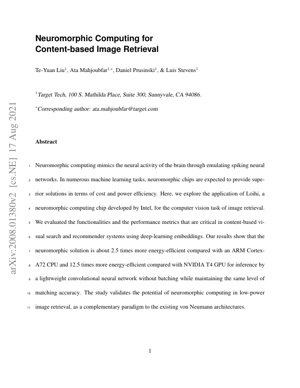
2.5x
More efficient than ARM CPU
12.5x
More efficient than NVIDIA T4 GPU
Same Accuracy
Maintained matching performance
1. Introduction
Neuromorphic computing represents a paradigm shift from traditional von Neumann architectures by mimicking the brain's neural activity through spiking neural networks (SNNs). This research explores the application of Intel's Loihi neuromorphic chip for content-based image retrieval (CBIR), demonstrating significant improvements in energy efficiency while maintaining competitive accuracy compared to conventional processors.
2. Methods
2.1 ANN to SNN Conversion
The methodology involves converting trained artificial neural networks (ANNs) to spiking neural networks using rate-based encoding. The conversion process maintains the network's functional capabilities while adapting to the event-driven nature of neuromorphic hardware.
2.2 Loihi Deployment
Intel's Loihi chip implements the SNN with specialized hardware for spiking neural computations. The deployment process involves mapping the converted SNN to Loihi's neurocores and configuring the spike communication protocols.
3. Technical Implementation
3.1 Mathematical Framework
The spiking neuron model follows the leaky integrate-and-fire (LIF) dynamics:
$\\tau_m \\frac{dV}{dt} = -[V(t) - V_{rest}] + R_m I(t)$
where $\\tau_m$ is the membrane time constant, $V(t)$ is the membrane potential, $V_{rest}$ is the resting potential, $R_m$ is the membrane resistance, and $I(t)$ is the input current.
3.2 Network Architecture
The implemented SNN architecture consists of convolutional layers followed by fully connected layers. The network was trained on Fashion-MNIST dataset and adapted for feature extraction in the image retrieval pipeline.
4. Experimental Results
4.1 Performance Metrics
The system achieved comparable retrieval accuracy to conventional CNN-based approaches while significantly reducing power consumption. The embeddings generated from temporal spike patterns proved effective for nearest neighbor search in the visual feature space.
4.2 Energy Efficiency Analysis
Comparative analysis showed the neuromorphic solution was 2.5 times more energy-efficient than ARM Cortex-A72 CPU and 12.5 times more efficient than NVIDIA T4 GPU for inference tasks without batching.
5. Code Implementation
Below is a simplified pseudocode for the SNN-based image retrieval pipeline:
# SNN Image Retrieval Pipeline
class SNNImageRetrieval:
    def __init__(self):
        self.snn_model = load_snn_model()
        self.embedding_db = None

    def generate_embeddings(self, images):
        """Generate embeddings from spike patterns"""
        embeddings = []
        for img in images:
            spikes = self.snn_model.forward(img)
            embedding = self.extract_spike_features(spikes)
            embeddings.append(embedding)
        return embeddings

    def query_image(self, query_img, k=5):
        """Find k nearest neighbors for query image"""
        query_embedding = self.generate_embeddings([query_img])[0]
        distances = cosine_distance(query_embedding, self.embedding_db)
        nearest_indices = np.argsort(distances)[:k]
        return nearest_indices
6. Future Applications
Neuromorphic computing shows promise for edge AI applications, real-time video analysis, and low-power embedded systems. Future research directions include:
- Integration with transformer architectures for multimodal retrieval
- Development of online learning capabilities for dynamic datasets
- Application in autonomous systems requiring real-time visual processing
- Combination with quantum-inspired algorithms for enhanced performance
7. Original Analysis
This research represents a significant milestone in neuromorphic computing applications for computer vision tasks. The demonstrated 2.5-12.5x energy efficiency improvement over conventional processors aligns with the broader trend in AI hardware specialization, similar to the evolution seen in Google's TPUs and Graphcore's IPUs. The success of Loihi in image retrieval tasks suggests that neuromorphic architectures could become complementary to existing von Neumann systems, particularly for edge computing applications where power constraints are critical.
The approach of converting pre-trained ANNs to SNNs, as demonstrated in this work, follows established methodologies in the field. However, the innovation lies in applying this technique specifically to content-based image retrieval, a task that typically requires substantial computational resources. The maintained accuracy levels while achieving significant energy reductions validate the practical viability of neuromorphic solutions for real-world applications.
Compared to other emerging computing paradigms like quantum machine learning or photonic computing, neuromorphic computing offers the advantage of closer compatibility with existing neural network frameworks. As noted in the IEEE Transactions on Pattern Analysis and Machine Intelligence, the energy efficiency of neuromorphic systems makes them particularly suitable for always-on AI applications and IoT devices. The integration of temporal dynamics in SNNs also opens possibilities for video processing and sequential data analysis that go beyond static image retrieval.
Future developments could explore hybrid architectures combining the strengths of conventional deep learning with neuromorphic efficiency, similar to approaches discussed in Nature Machine Intelligence. The scalability of these systems to larger datasets and more complex retrieval tasks remains an important research direction, as does the development of specialized training algorithms that directly optimize for neuromorphic hardware rather than relying on ANN-to-SNN conversion.
8. References
- Liu, T.-Y., et al. "Neuromorphic Computing for Content-based Image Retrieval." arXiv:2008.01380 (2021)
- Davies, M., et al. "Loihi: A Neuromorphic Manycore Processor with On-Chip Learning." IEEE Micro (2018)
- Maass, W. "Networks of spiking neurons: The third generation of neural network models." Neural Networks (1997)
- Roy, K., et al. "Towards Spike-based Machine Intelligence with Neuromorphic Computing." Nature (2019)
- Xiao, H., et al. "Fashion-MNIST: A Novel Image Dataset for Benchmarking Machine Learning Algorithms." arXiv:1708.07747 (2017)
- Merolla, P. A., et al. "A million spiking-neuron integrated circuit with a scalable communication network and interface." Science (2014)